
Creating healthy discourse between Pro-Lifers and Pro-Choicers
The SMU Feminist Equality Movement (FEM) and Mustangs for Life collaborated to host “Dialogue, Not Debate” in which four panelists discussed the topic of abortion and women’s right in the Hughes Trigg Student Center.
The panel was composed of one SMU student and one expert on each side. On the pro-life side was SMU student and Mustangs for Life president Sean Doyle, and Kassi Marks J.D., an Attorney at Law at Leger Ketchum & Cohoon, PLLC. Marks specializes in protecting human rights at all stages of life, from conception to death. On the pro-choice side was Averie Bishop an SMU student and founder of “Get Sex Ed”, which is an evidence-based sexual education series on YouTube. She was accompanied by Rev. Dr. Daniel Kanter, Sr. Minister of the Unitarian of Dallas and a Board Member of Planned Parenthood of Greater Texas.
Lamisa Mustafa, vice president of SMU FEM, organized this year’s panel.
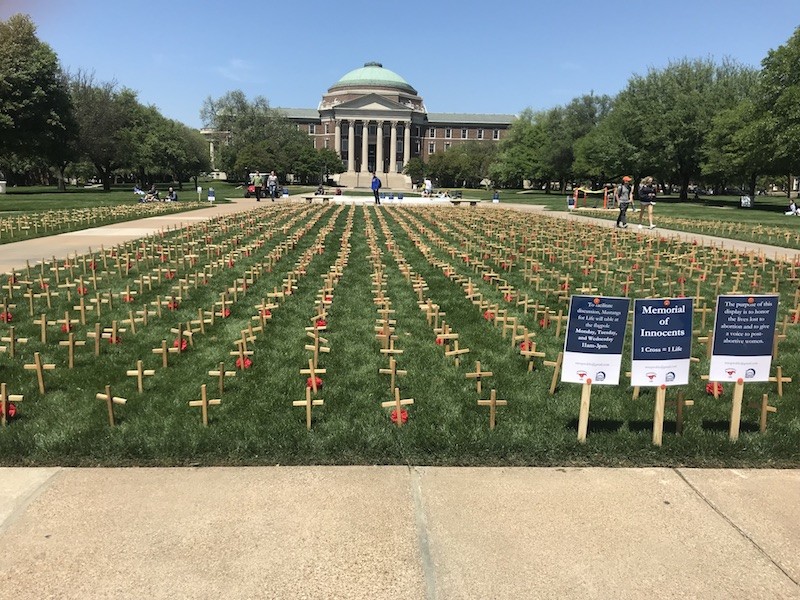
“This is the SMU Feminist Equality Movement’s constructive response to the Mustangs for Life’s display on Dallas Hall Lawn. This is our third year doing this together, and we see this hopefully as a teachable moment for people to consider both sides of this very divisive issue… We think that this is a great way to show people that there is so much more to the issue than abortion,” Mustafa said.
Going into the “Dialogue, Not Debate”, I lean pro-life, but I’m not a purist and have many exceptions. My roommate and I frequently discuss the issue of abortion. She’s a strong pro-choice advocate, and we’ve learned a lot from each other. Our respectful discussions are what inspired me to come to this event. I hoped to find more clarity and have a better understanding of both sides.
The first part of the debate began by each panelist explaining why they hold the opinion they have. Each panelist had great answers, but the one that struck a chord with me was Averie Bishop’s. She explained how when she became sexual active, she wanted to get tested for STDs and STIs. After a google search, she found a women’s clinic. To her surprise, this clinic was not providing the kind of healthcare she needed.
“I was taken into a backroom where a women came in with a Bible in her hand. She sat me down and began to quote the Bible to me. In that moment, I knew that I had found myself at a crisis pregnancy center… They’re centers that disguise themselves as clinics and often times they shame, lie, and mislead women in regards to reproductive health to dissuade them from abortions or accessing contraception,” said Bishop.
As a woman who went to a Catholic school all my life, I had a lot of sympathy for her traumatic experience. The only sexual education taught to us was abstinence and natural family planning (lessons to be taken with a grain of salt when they are taught by a man with 5 kids and counting). Thankfully, many of my friends and I had access to adults who openly discussed it with us, but this didn’t mean we were safe from criticism from ours peers. Gossip about couples being intimate or things going down at last weekend’s party were frequently followed by hurtful names and comments. Because of these experiences, I understand Bishop’s frustration. One of the frequent pro-life arguments is that women can receive affordable healthcare from other clinics that don’t provide abortions. While this may be true, no one deserves to be shamed or have religion pushed upon them during a routine STD testing.
The panelists found middle ground in agreeing that we all want to decrease the number of abortions and increase access to sexual education. I was happy to hear this because I think there are common misconceptions of both sides that would say otherwise. For example, people who are pro-choice must love abortions, and people who are pro-life must not care about women’s reproductive healthcare.
Kassi Marks on the pro-life panel actually experienced an unplanned pregnancy while she was still in law school. Although she found that her pregnancy was a blessing in disguise, she was scared and had six figures of student loans to pay off. For the reason, she hopes more women and men will take the time to educate themselves on reproductive health and fertility.
“Let me do a little commercial here for a book that I read… It’s called Fertility Awareness Method. It’s not natural family planning, it’s not based on a religious viewpoint, but it’s based on biology. And if you want to learn exactly how fertility works for women, when you can and cannot get pregnant, the cycle and how that works, complications in cycles… All those things based on science and biology with a neutral viewpoint in terms of faith and morality,” said Marks.
Out of everyone in the room, Rev. Dr. Daniel Kanter said he spends the most amount of time in abortion clinics. Kanter volunteers as a chaplan at Planned Parenthood and provides counseling for women and couples before abortions. He explained how he firsthand witnesses each unique experience and how many times it’s a difficult one:
“I did a chaplan for an Evangelical couple who were pro-life, but they had to have an abortion because they had a fetal anomaly. The fetal anomaly was either going to hurt or kill the woman. They were in a desperate place,” Kanter said.
Kanter also explained that to him, life is defined by experience and therefore life begins at first breath. This was a different viewpoint that I hadn’t really heard before. I primarily heard pro-choice people believing that human life begins when the fetus is viable on its own, outside the womb. Personally, I try to keep my opinion on the beginning of human life consistent with the end of human life. When your heart stops beating, you die, so it seems logical to me that human life begins with the heartbeat, which begins to beat around 18-22 days after conception.
One of the main points made by Sean Doyle on the pro-life side was creating a culture of life.
“I have a consistent life ethic. I’m anti-war, anti-gun violence, anti-death penalty, anti-human trafficking, and I’m pro-life. I think those mesh really well. And ya know there are some pro-lifers out there who could do a better job of understanding that, but also the pro-choice side should understand that,” Doyle said.
I agree with Doyle’s idea of a consistent life ethic, and that many times our society promotes a toxic culture. One of the largest reasons I lean pro-life is because I don’t believe a disability is reason enough to abort the child. Studies show that in recent years, 67-85% of unborn children diagnosed with Down syndrome are aborted in the United States. In other countries, it can be upwards of 90%. I think this is because our society, especially in eye of social media, is so focused on perfection. Although I acknowledge the fact that not all parents have the finances to provide for children with disabilities, I find those statistics too high for that to be the only scenario in which these abortions happen.
After leaving this event, I feel that I have strengthened my awareness and understanding of both sides. Although these panelists do not speak on the behalf of the pro-life or pro-choice movements as a whole, it’s so important to actually listen to people and their reasoning behind their beliefs. After all, a “marketplace of ideas” is what makes a great democratic society. No matter which side you’re on, remember that the way you feel and think is based on your own experiences. We must not judge or hate someone for their stance on any issue, because their experiences are what shaped a different perspective from your own.
I think we can all agree that we want women to be happy and safe, an increase in real sexual education, and a decrease in abortions. And remember, you get further with honey than you do vinegar, so be kind to each one another.
 audreyeliza.com